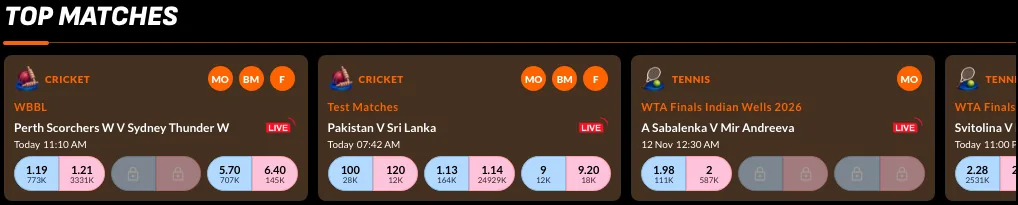
FairPlay betting is built around an exchange. You back an outcome to happen or lay it not to happen, and another user takes the other side. On 11 November 2026 the front page of fairplay.global showed markets on 15 sports, led by cricket, with blue back prices, pink lay prices and the money already matched at each. A Sportsbook tab also exists, but it opens only after login. Offering any of this to people in India has been illegal since 1 May 2026.
How does the FairPlay betting exchange work?
Look at the first card in our screenshot: Perth Scorchers Women against Sydney Thunder Women in the WBBL. For the Scorchers, the blue box said 1.19 and the pink box 1.21. For the Thunder it was 5.70 and 6.40. The small numbers underneath (773K, 3331K and so on) show how much money was waiting at each price.
Backing is the familiar part. Back the Scorchers with ₹1,000 at 1.19 and, if they win, you get ₹1,190 back, a ₹190 profit. Laying is where people get hurt. Lay the Thunder at 6.40 for ₹1,000 and you’re playing the bookmaker: if the Thunder lose, you keep the backer’s ₹1,000; if they win, you owe ₹5,400. A bet that “almost always” comes in can wipe out weeks of small wins in one evening. These sums leave out the exchange’s commission, which FairPlay doesn’t show to visitors.
What do MO, BM and F mean on FairPlay?
Each cricket card carries three orange badges: MO, BM and F. The site doesn’t explain them. On Indian exchange platforms they normally stand for Match Odds (the main exchange market), Bookmaker (fixed prices set by the house) and Fancy (side markets such as runs in a session). Tennis cards carried only MO. Some cricket cards also showed prices like 100 and 120 instead of decimals. That points to a different rate format in those markets, which we couldn’t open without an account.
Which sports and markets does FairPlay cover?
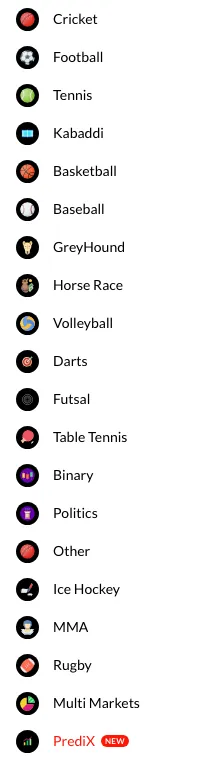
The left-hand menu lists 15 sports: cricket, football, tennis, kabaddi, basketball, baseball, greyhound racing, horse racing, volleyball, darts, futsal, table tennis, ice hockey, MMA and rugby. After them come four entries that aren’t sports at all: Binary, Politics, Other and Multi Markets. PrediX, tagged NEW, sits at the bottom.
Cricket gets the most space. On the day we checked, the Top Matches row had a Women’s Big Bash League game, the Pakistan v Sri Lanka and Afghanistan v Zimbabwe Tests, and ODIs between New Zealand and India and between Australia and England. The Politics entry points to election-type markets, which sum up the legal position neatly: in India they’re banned whoever wins.
Exchange or sportsbook: which is which on FairPlay?
The top menu splits things into Home, Inplay, Sportsbook, Casino and Multi Markets. Inplay and the front page show exchange prices. Sportsbook is a separate fixed-odds product, where you bet against the house at prices it sets. It sends visitors straight to the login form, so we can’t compare its prices with the exchange. Multi Markets lets you follow several markets at once.
Is FairPlay cricket betting legal in India?
No. The Online Gaming Act bans online money games of every kind, with up to three years in jail and a ₹1 crore fine for whoever offers them. Players aren’t the target, but you’d be betting through a company that has no Indian approval, can be blocked at any time and can’t be made to pay you. FairPlay’s cricket story already includes the ED case that grew out of a 2023 complaint about unlicensed IPL streaming.
A different bookmaker may be waiting on the other side of that link, and it isn’t for anyone placing bets from India.